Ask a class of teenagers to name ten brand logos and they will not pause. Ask for ten native birds and the room goes quiet. That gap has a name — declining species literacy — and it is well documented. It also has a consequence Konrad Lorenz put plainly decades ago: people protect what they love, and love only what they know. If the next generation cannot recognise the wildlife on its own doorstep, it will not defend it.
The phone is usually cast as the villain in that story. With the Porini Foundation, a Swiss conservation non-profit, we decided to flip it — and turn the device already in every pocket into a reason to go outside.
Scan, collect, duel
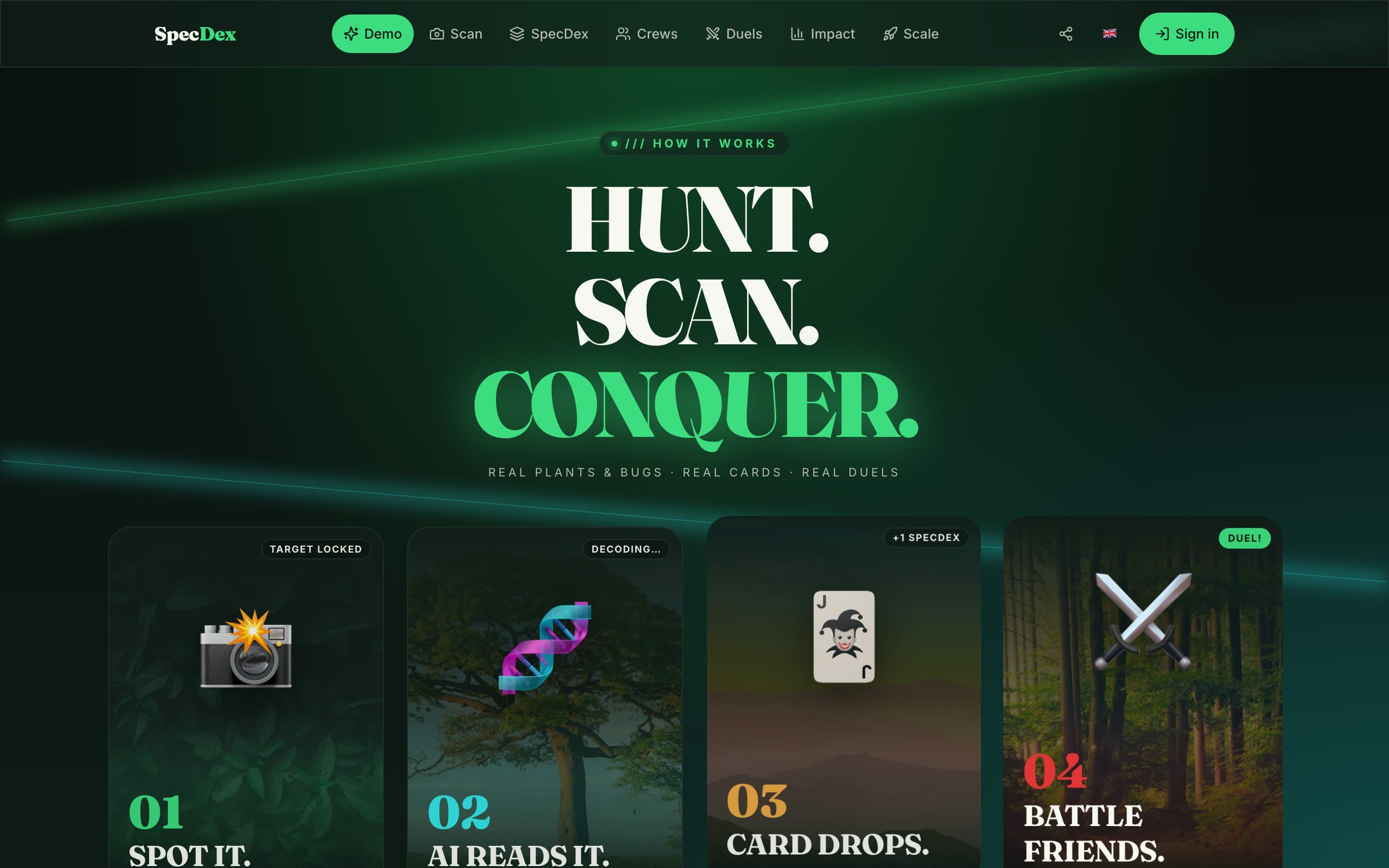
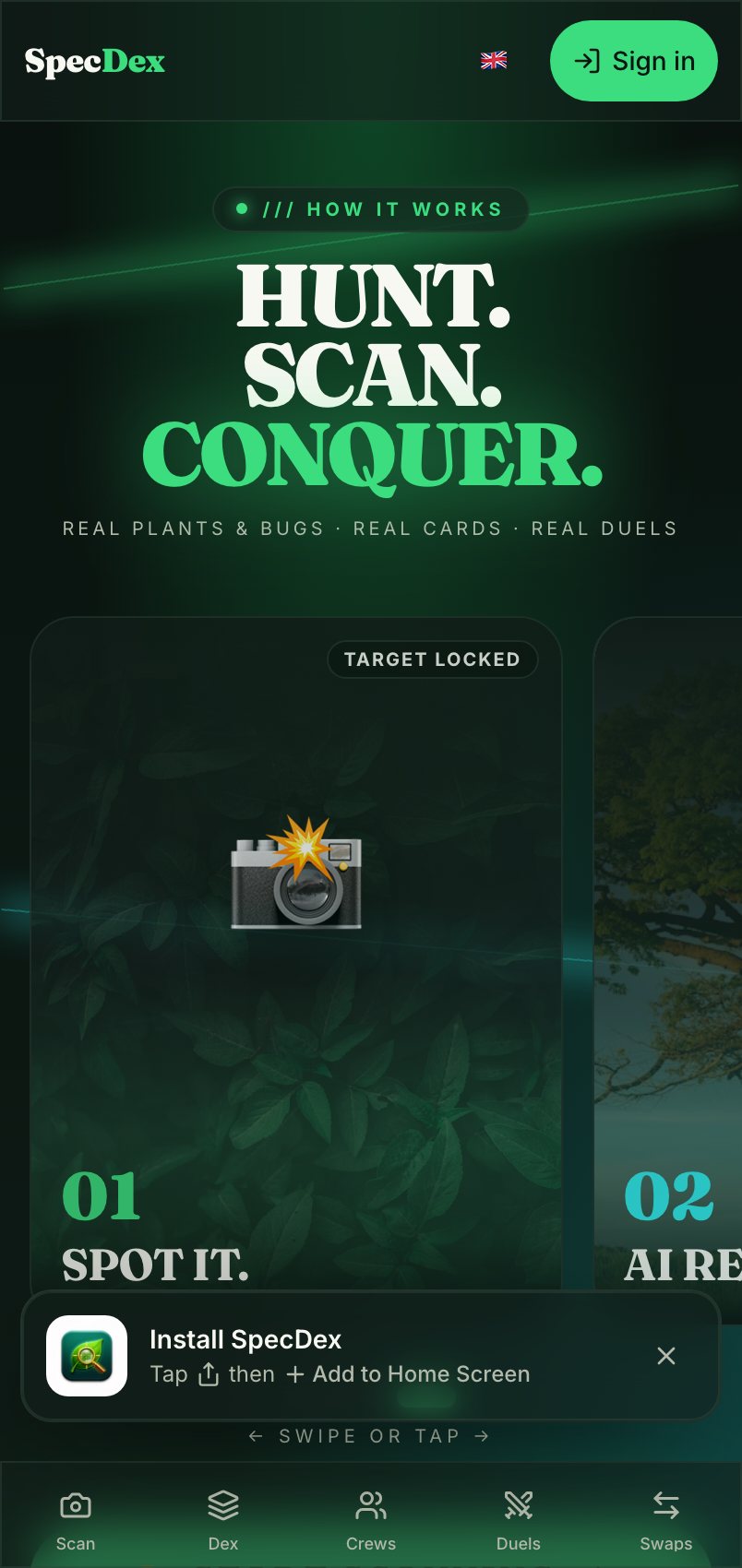
SpecDex is a mobile-first, zero-install web app — open a link, no app store, no download. It runs one simple loop.
Scan. A player photographs a real plant or animal. AI image analysis (Google Gemini) identifies the species and reads its ecological traits — habitat, rarity, its role in the food web.
Collect. The find becomes an illustrated creature card with ecology-true stats: pollinator or predator, native or invasive, producer or grazer. The card is honest biology, not fantasy, and it fills the player's personal species collection.
Duel. Friends face off in friendly card duels resolved by real food-web relationships — a predator beats its prey, an invasive overwhelms a native, a pollinator lifts a producer. There is no pay-to-win and no luck to hide behind: knowing the ecology is how you win.
Built to send you outdoors — and to protect the people playing
A game that gets children outside must not trap them on a screen. So SpecDex is deliberately anti-addictive: streaks come with a weekly «forgiveness shield» so one missed day never punishes you, and daily quests are deterministic — no reroll treadmill, no manipulative loops. The pull is meant to be the forest, not the notification.
Because many players are minors, privacy is designed in, not bolted on. Pseudonyms only, never real names. The locations of rare species are hidden to prevent poaching. And a GDPR- and nDSG-compliant «class-only mode» keeps school pupils out of any global ranking. There is no blockchain and there are no NFTs — a design decision, not an oversight.
Every scan does double duty: it enriches an anonymised local biodiversity dataset, turning a class walk into real citizen science. SpecDex speaks four languages — German, French, Italian and English — and it is built, live and functional today at gameify.operal.tech.
Give a child a card for the sparrow they just found, and you have given them a reason to look for the next one.