A Swiss family vintner can make medal-worthy wine and still struggle to get a single case onto a foreign shelf. The bottleneck isn't the wine — it's distribution. In most export markets the wine that reaches a restaurant table has passed through an importer, and finding the right one is genuinely hard. Public directories are years out of date. The best importers are referral-gated and don't answer generic mail. And a cold email that ignores what an importer already carries gets ignored right back.
Done properly, sourcing one market is a junior's month of spreadsheet work: comb the directories, read each importer's portfolio, screen out anyone who already represents a competing estate, rank the rest, then write a personalised note in the right language. Repeat for every target country. Most small estates simply never do it.
Five agents instead of a spreadsheet
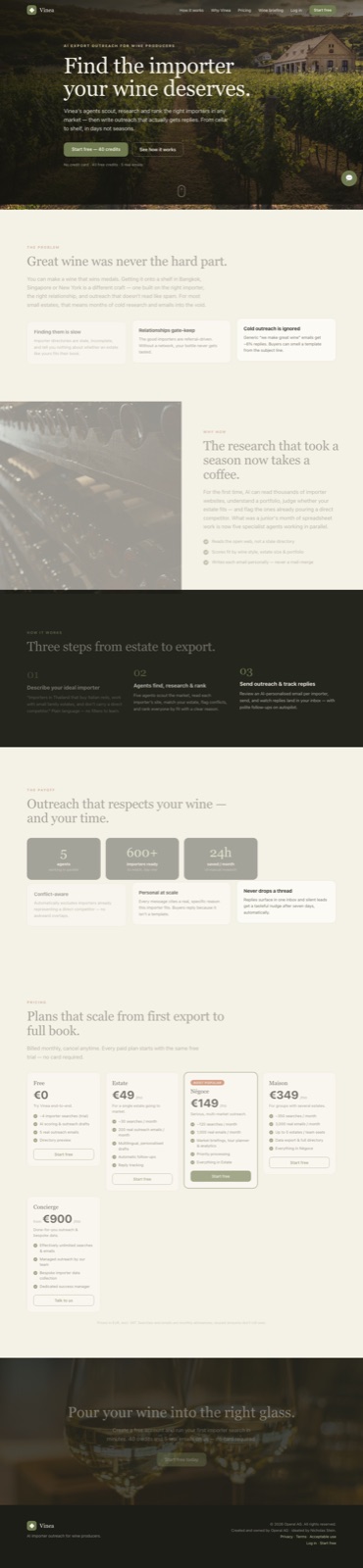
For a Swiss wine estate, we built Vinea — an importer-outreach engine that turns a plain-language brief ("I want to place a Pinot Noir in Scandinavia") into a ranked shortlist. Under the hood, five agents work in sequence: a Database Scout finds candidate importers, a Site Researcher reads their live websites, a Portfolio Analyst works out what they actually carry, a Conflict Check flags anyone already representing a competing wine, and a Match Ranker scores the rest for fit. Progress streams to the screen as each agent reports.
The output isn't a raw list — it's a conflict-aware shortlist with a reason attached to every name. Vinea then drafts personalised, multilingual outreach per importer, tracks replies, and sends an automatic follow-up if a week passes in silence.
A microsite grown from satellite data
The second half of Vinea is about the story an estate tells. From public Earth-observation data alone — Sentinel-2 NDVI for vine vitality, Copernicus DEM for terroir, Open-Meteo for climate — Vinea generates a satellite vineyard microsite: a 3D flyover, a before/after NDVI slider, a terroir profile, and a downloadable PDF dossier an importer can forward internally.
Crucially, the honesty is baked in. Satellite evidence can speak to location, vine vitality and canopy — and nothing else. It says nothing about organic certification or how the wine tastes, so every microsite carries a mandatory methods footnote stating exactly what the data does and doesn't show. Anti-greenwashing isn't a disclaimer here; it's a design rule.

Built once for one estate, Vinea is now a multi-tenant SaaS with a credit-based free tier at vinea.operal.tech — so any vintner can point AI agents at the shelf they've never been able to reach.